These are the published head-to-head comparisons from the artificial turf trade, set out as guidance for choosing. Every row is quoted as published. We do not install turf, we do not test materials, and no row here is an endorsement of a product or a provider — it is the published position on what each option is, what it costs, and how it behaves over the fifteen to twenty years a lawn is expected to last.
Artificial turf vs. natural grass
| Factor | Artificial turf | Natural grass |
|---|---|---|
| Water | Zero watering | 30,000+ gallons a year for an average lawn |
| Maintenance | No mowing, no fertiliser | Weekly mowing plus inputs |
| Upfront cost | 8 to 15 per sq ft installed | 0.50 to 2 per sq ft seed or sod |
| Lifespan | 15 to 20 years | Ongoing renewal |
| Feel | Always-green surface, no mud | Natural feel, lower upfront cost |
The published summary of this pair is short: turf means no watering and no mowing with a 15-year lifespan, grass means a natural feel at a lower upfront cost. The water row is the one that carries into the running maths — a 1,000 to 2,000 square foot lawn watered at 73 gallons per square foot a year is published as 73,000 to 146,000 gallons saved annually, 500 to 1,500 a year off the water bill at local rates.
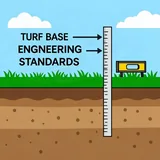
One row is missing from the comparison because the trade does not publish it as a number: the base. The same lawn costs different amounts to build depending on the excavation depth and the aggregate under it, which is why two quotes for the same square footage can be honest and far apart.
Infill vs. no-infill turf
| Factor | Infill | No-infill turf |
|---|---|---|
| Feel | Soft, blades stand up | Flat, less spring |
| Longevity | 15 to 20 years | Shorter, blades mat down |
| Heat | Infill holds some heat | Similar |
| Cost | Included in the 8 to 15 range | Slightly less |
The published guidance is to choose infill for a natural-feeling, long-lasting lawn and no-infill only for the cheapest synthetic option. Beyond the feel rows, infill is ballast: it adds weight so the surface stays flat and does not creep, it props the fibres upright so the lawn keeps its fresh-cut look, and it protects the backing from abrasion against the base. Published maintenance follows from that — infill is topped up every 1 to 2 years in heavy-use areas.
Infill material is a separate decision from the infill-or-not question. Silica sand is the published standard infill, and in a pet yard it is the wrong one, because it absorbs liquids and packs together into an odour reservoir. Zeolite and antimicrobial infills are published as the pet-yard alternatives for the reasons in the row below.
Artificial turf vs. gravel and native planting
| Factor | Artificial turf | Gravel and native planting |
|---|---|---|
| Look | Always-green lawn | Rock, gravel, native plants |
| Maintenance | Occasional brush and rinse | Seasonal weeding, plant care |
| Cost | 8 to 15 per sq ft installed | 3 to 8 per sq ft installed |
| Environment | Synthetic materials | Natural habitat, pollinator-friendly |
This is the pair that most often decides a front yard. Both remove the lawn's water demand, and the published comparison is on look, maintenance and upfront cost rather than on water. The published guidance is to choose turf for the look and feel of a lawn with zero water, and gravel and native planting for a natural, wildlife-friendly landscape with native planting.
Where the two are combined rather than chosen between, the published detail that matters is the edge: turf is trimmed and pinned against the border, and the finished compacted base is set 1.5 inches below the top of the edging so the surface and the infill finish flush with whatever hardscape or gravel sits beside it.
Pet-friendly vs. standard artificial turf
| Factor | Pet-friendly turf | Standard artificial turf |
|---|---|---|
| Drainage | Fast-drain backing, urine passes through | Slower drainage |
| Odour | Rinses clean with the right infill | Can hold odours |
| Durability | Heavier backing built for claws | Standard wear |
| Cost | +1 to 3 per sq ft over standard | Base specification |
| Base | 4-inch minimum excavation | 2 to 3 inches for light traffic |
On top of the row above, the pet specification is published as three component changes: a backing that is permeable edge to edge instead of hole-punched, an antimicrobial or zeolite infill instead of untreated silica sand, and antimicrobial fibres rather than standard nylon. Alongside them sits the base change, because a 4-inch minimum excavation with open-graded stone is what gives the extra liquid somewhere to go. Published drainage for a specialist pet system is 30+ inches per hour.
A summary rather than a full table: open-graded vs. dense-graded base
One comparison in the published set carries a summary rather than a table of cost rows, and it is the one that decides everything above it. Open-graded: washed, angular stone such as #57 or CA7, clean of fines, locking together under compaction to leave roughly 40 percent void space — a continuous network of drainage channels. A published side-by-side test measured it draining at over 12 inches per hour. Dense-graded: Class II road base, CMB or decomposed granite, packed with the microscopic dust, sand and clay the trade calls fines, which compact into a concrete-like crust with essentially no void space. Published uses for a dense-graded base are a standard residential lawn with light foot traffic and no dogs, and the base under a backyard putting green, where a smooth, ultra-compacted surface is the priority. It is published as the wrong base for any yard a dog uses daily.
Two related rows go with it. Rounded stone such as pea gravel is published as unusable in a turf base at any depth, because rounded stones never lock together and the turf above them shifts, buckles, wrinkles and sinks — and the industry compaction target of 95% Standard Proctor cannot be reached with them. The weed barrier is the third row: non-woven geotextile belongs at the bottom of the excavation beneath the stone, where it stops clay migrating up into the clean voids, and never directly under the turf backing, where it behaves like a felt pad and becomes a permanent source of ammonia odour.
How to use these rows when you choose
Every row above is a published position rather than a measurement of your yard, and the yard decides the rest. Put these questions to each professional you speak to:
- Which option performs best in Boise's climate and soil conditions?
- Can you show me recent Boise projects with this option, with photos?
- What does the warranty actually cover — material, workmanship, or both?
- What is the realistic timeline and total installed cost for my property?
- What excavation depth are you building to, and is the aggregate named in the contract — #57 or CA7, not "gravel"?
- What compaction standard do you build to, and how do you verify it?
- Where in the base does the weed barrier go?
Then set the answers beside the rows above. A quote that beats the published cost band is usually beating it on scope rather than on price — a thinner base, a dense-graded stone, a sand infill in a pet yard, or no geotextile separator at all.
Frequently asked questions
Artificial turf or natural grass?
The published row: artificial turf is 8 to 15 per square foot installed, needs zero watering and no mowing or fertiliser, and is published at a 15 to 20 year lifespan. Natural grass is 0.50 to 2 per square foot for seed or sod upfront, needs weekly mowing plus inputs, and its longevity row is ongoing renewal. The published summary is the two lines side by side: turf means no watering and no mowing with a 15-year lifespan, grass means a natural feel at a lower upfront cost.
Infill or no-infill turf?
Infill is published as soft with blades that stand up, a 15 to 20 year lifespan, and a cost included in the 8 to 15 per square foot range. No-infill is published as flat with less spring, shorter-lived with blades that mat down, and slightly less expensive. Infill also does the structural work: it ballasts the surface so it stays flat, holds the fibres upright, and protects the backing from grinding against the base.
Artificial turf or gravel and native planting?
Artificial turf is 8 to 15 per square foot installed and reads as an always-green lawn with occasional brushing and rinsing as its maintenance. Gravel and native planting is 3 to 8 per square foot installed and reads as rock, gravel and native plants, with seasonal weeding and plant care. The published environment row is the trade-off in the other direction: turf is synthetic materials, while gravel and native planting is natural habitat and pollinator-friendly.
Pet-friendly turf or standard turf?
Pet-friendly turf is published at 1 to 3 per square foot over standard and buys four specific differences: fast-drain backing that urine passes through against slower drainage; an infill that rinses clean rather than holding odours; a heavier backing built for claws against standard wear; and a base requirement of a 4-inch minimum excavation. If dogs use the yard daily, the pet rows are the ones that decide whether the lawn still smells right in year three.