Seven artificial turf clips are published on this page, and none of them is passed off as footage from a Boise installation. Together they walk the sequence a build actually runs in, the chemistry behind pet odour, the 48-hour treatment that reverses it, the flaws that stay buried under a bad base, and the checks to run before any deposit changes hands. Everything they cover is also written up for Boise specifically: the cost bands, the base specification, the aggregate, the drainage and the infill.
Watch
Watch: the anatomy of a turf failure - what is under the surface
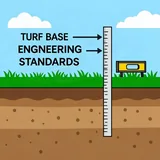
- Excavation depth: four inches minimum, six in heavy clay, compacted in damp two-inch lifts to 95 percent Proctor.
- Weed fabric laid under the backing behaves like a pad and holds odour - the separator belongs at the bottom of the dig.
- Seams cut to a one to two millimetre gap with jointing tape, and edge restraint set 1.5 inches below the edging.
· planning walkthrough, not filmed in Boise
Watch: why cheap artificial turf smells like ammonia
- Uric acid crystals are not water soluble, so hosing and enzyme sprays do not reach them.
- The live-microbe, dusk-application, tarp method that digests them in 24 to 48 hours.
- The underground drainage fault that keeps bringing the odour back.
· planning walkthrough, not filmed in Boise
What the clips cover, in the order they run
The library opens at the start of a job rather than the end. How a turf installation actually runs, start to finish follows base prep, compaction, seaming and infill — the sequence a crew follows and the steps homeowners are told to skip. Why new turf smells like ammonia in the heat takes the chemistry apart: water and urea wash away, uric acid crystals do not, environmental bacteria feed on the crystals and off-gas ammonia, and the afternoon sun accelerates the whole reaction, which is why a yard can smell clean at 8am and reek by 2pm. The 48-hour turf odour cure, at 9 minutes 25 seconds, is the treatment itself: a concentrated live-microbe cleaner applied at dusk, a heavy tarp laid flat and weighted, 24 to 48 hours of dwell to hold the moisture, then a final rinse — with the published explanation of why enzymes fail outdoors and why bleach, vinegar and indoor carpet shampoos must never go near turf.
The next two clips move under the surface. Turf installation flaws: what is buried under the surface, at 7 minutes 24 seconds, is a forensic walk through the mistakes hidden under synthetic grass — no sub-base drainage, an under-compacted base, and the wrong aggregate depth, published as 1.33 tons per 100 square feet at four inches — and how each one shows up months later. The turf vetting checklist before you pay a deposit, at 9 minutes 3 seconds, turns that into questions: base depth and compaction, the aggregate by name, where the weed barrier goes, how seams and infill are handled, and the licence and insurance to ask for first. Drainage disaster: the short version, at 1 minute 29 seconds, is the demonstration — liquid poured through a standard dense-graded base against clean crushed stone, the 40 percent void space that makes the difference, and the drainage rate that separates them. Turf disasters: the hidden danger under the surface, at 8 minutes 7 seconds, closes the set with the warning signs that appear before a surface fails.
What is not published here yet
No clip filmed in Boise is on this page, and no date is promised for one. What is missing is local footage — the aggregate as it arrives and how deep it is spread, the compaction in damp 2-inch lifts, the geotextile at the bottom of the excavation, the seams and how they are joined, the infill brushed in and how many pounds per square foot went down, and the real installed numbers from a Boise yard. When those clips exist they will be published here. Until then the written guides carry the local detail: the cost guide, the FAQ, the options comparison and the problem guides below.
Read the same material now
The written guides cover all of the above and do not depend on a video being published.
- Artificial turf cost guide — the published per-square-foot bands, the build lines, the aggregate quantities and the compaction standard
- Artificial turf FAQ — cost, base depth, aggregate, odour chemistry, infill, lifespan, heat, maintenance and the transparency answers
- Options compared — artificial turf vs natural grass, infill vs no-infill, turf vs gravel and native planting, and pet-friendly vs standard turf
- Problem guides — five failure modes and what each one means
- Free tools and calculators — cost, sub-base aggregate and compaction, pet drainage and odour risk, the tarp-method planner, sizing and seams, and the paw-safety diagnostic
- How the free matching works — and how to compare itemised quotes
Why we will not post filler video
Generic footage of a finished lawn tells you nothing about your base, your drainage or your quote. The clips above earn their place because they walk the decisions a build is actually made in — the sequence, the chemistry, the base, the drainage, the checks to run before you pay — and none of them is passed off as work done in Boise. A clip only takes the lead of this page when it shows work done in this area, on ground and in a climate that behaves like yours. When that footage exists, it replaces the explainer set at the top of the page.
Frequently asked questions
Which artificial turf videos are published on this page?
Seven clips, and the runtimes are published on five of them. They cover how an installation runs from base prep through compaction, seaming and infill; why new turf smells like ammonia in the afternoon heat; the 48-hour odour cure at 9 minutes 25 seconds; the installation flaws buried under a failed surface at 7 minutes 24 seconds, including the aggregate depth of 1.33 tons per 100 square feet at four inches; the vetting checklist to run before a deposit at 9 minutes 3 seconds; the drainage disaster short at 1 minute 29 seconds; and the hidden danger under the surface at 8 minutes 7 seconds. Each subject also has a written guide on this site.
Was any of it filmed in Boise?
No. These are explainer and planning walkthroughs and the page labels them that way. No clip filmed in Boise is published yet and no date is promised — what is missing is local footage: the aggregate as it is delivered, the compaction in lifts, the base the turf sits on, the seams and the infill, and the installed figures from a Boise job. Those subjects are covered in writing on this site in the meantime.