A turf quote is easy to read and hard to judge. The price covers work that stays invisible for years, and the difference between a yard that drains for a decade and one that smells by its second summer is decided in details nobody photographs. Vetting is simply asking about those details and listening for specifics. Here is the short list that does the most work in Boise, in the order that matters.
Start With License and Insurance
Before the technical questions, confirm the two credentials that protect your property: an active ID contractor license and current liability insurance, plus workers compensation covering the crew. If an uninsured worker is hurt on your property or damages it, you can be left holding that liability, and unlicensed crews are repeatedly the source of the shortcuts that produce odor traps in the first place. Ask to see the certificate, not just the company name on a yard sign.
The Two Material Questions
The first technical questions are about what goes under the grass. Which aggregate will you specify — open-graded angular stone such as #57 clean crushed stone or CA7, or a dense-graded road base? Dense-graded bases are packed with fines that clog drainage and hold odor, while open-graded washed stone keeps roughly 40% void space for rapid vertical drainage. Where exactly in the base layers will the weed barrier be placed? The answer has to be the very bottom of the excavation, underneath the stone base. Fabric placed directly under the turf backing acts like a felt pad that absorbs urine and locks in a permanent ammonia smell.
Both answers belong in the contract with the material names attached, not in a verbal promise made in the driveway.
The Two Engineering Questions
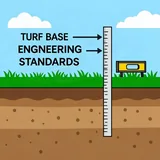
Then the numbers. How deep will you excavate, and what does that depth support? A pet yard needs a minimum 4-inch compacted base to handle frequent flushing, because a shallow base settles unevenly and ponds. What compaction target do you build to, and how do you verify it? The standard is 95% Standard Proctor density, reached in damp 2-inch lifts with a plate compactor — not by dumping the full depth of stone and rolling it once. A crew that cannot define compaction or name a density target is telling you there is no measurement behind the work.
The Odor-Chemistry Questions
If dogs use the yard, ask three more. What backing does the turf have — a standard hole-punched backing, where liquid pools between the holes, or a fully permeable, edge-to-edge flow backing? What infill goes between the blades — untreated silica sand, which absorbs liquids and becomes an odor reservoir, or zeolite or an antimicrobial infill? And how would they treat an existing smell: enzyme sprays or live-microbe cleaners? Enzymes only chop up odor molecules and leave the waste behind, so the smell returns as soon as the turf is hot or wet again; live bacteria digest the non-soluble uric acid crystals and convert them into odorless carbon dioxide and water.
The Paperwork, References and Quotes
Finally, make the specification enforceable. Ask for turf spec sheets quoting face weight and pile height, and for a warranty that covers material and workmanship separately, including whether the seams are guaranteed. Ask for references from installations at least two years old rather than this season's showpieces. And get at least three quotes written to the same scope of base work, so the comparison is between bases rather than between grass colors.
Published guidance puts a full professional installation at roughly 8 to 15 per square foot, with a pet-capable build at the higher end of that band and a pet upgrade adding a couple of dollars per square foot on top. A quote well under the band has almost certainly removed a layer you cannot see.
What a Good Answer Sounds Like
You do not need to know the answers to judge them. You need to hear how a contractor answers. Specific stone names, a density figure, a depth, a fabric placement — those are the marks of a crew that has built the system before. Deflection, trade secrets and everyone-does-it-that-way are the marks of one that has not. Boise Artificial Turf Pros is an independent matching service, not a contractor. We do not install, repair, inspect or warranty turf, and we do not employ contractors. We match homeowners in Boise and across the Treasure Valley with local providers — up to 3 matches, within one business day, and 100% free.
Frequently asked questions
What should I check before hiring a turf installer?
Start with an active state contractor license and current liability insurance, including workers compensation. Then confirm the base specification in writing: the stone type, the excavation depth and the compaction target.
What is the single most important technical question?
Where the weed barrier is placed. It belongs at the very bottom of the excavation, underneath the stone base. Fabric placed directly under the turf backing acts as a felt pad that absorbs urine and holds a permanent odor.
What compaction standard should a base be built to?
95% Standard Proctor density, achieved in damp 2-inch lifts with a plate compactor. A crew that cannot name a density target or explain how it is verified is not building to a measured standard.
What infill should a pet yard use?
Zeolite or an antimicrobial infill rather than untreated silica sand. Silica sand absorbs liquids and packs into an odor reservoir, while zeolite is a negatively charged mineral that traps the positively charged ammonium ion until rain or a rinse flushes it into the drainage stone.
How many quotes should I get?
At least three, written to the same scope of base work, so the comparison is between the foundations rather than between grass colors. Ask for spec sheets and references from installs at least two years old.
Sources
- USDA-NRCS Web Soil Survey (soil series, drainage class and water table for the parcel)
- USDA-NRCS Official Soil Series Descriptions (clay and hardpan behavior under the base)
- EPA UV Index scale (very high to extreme UV days and surface exposure)
Related
Artificial Turf services in Boise
Boise Artificial Turf Residential Turf
A residential turf installation is a drainage and sub-base project that ends in a lawn, and the published numbers only make sense once you know which of the two you are paying for.

Boise Artificial Turf Pet Turf
Pet turf is judged by what happens underneath it, not by how the blades look, and the published specification is a deeper, fully draining base plus an infill that changes the chemistry of the yard.
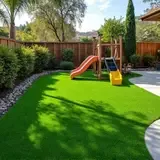
Boise Artificial Turf Playground Turf
A playground surface is bought for one number - the fall height it is rated to - and everything else about the installation serves that number.
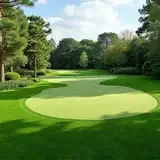
Boise Artificial Turf Putting Greens
A backyard putting green is a shaped base with a surface stretched over it, and the published specification starts with the speed number the surface has to deliver.
Boise Artificial Turf Commercial Turf
Commercial turf is published as a high-traffic, high-drainage surface, and the two numbers that decide whether it works are the annual hours it is rated for and how fast the base sheds water.
Areas we serve
Boise
Artificial Turf in Boise, ID - costs, water and soil notes.
Meridian
Artificial Turf in Meridian, ID - costs, water and soil notes.
Nampa
Artificial Turf in Nampa, ID - costs, water and soil notes.
Caldwell
Artificial Turf in Caldwell, ID - costs, water and soil notes.
Eagle
Artificial Turf in Eagle, ID - costs, water and soil notes.
Kuna
Artificial Turf in Kuna, ID - costs, water and soil notes.
Star
Artificial Turf in Star, ID - costs, water and soil notes.