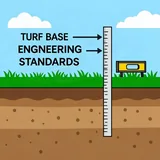
Pet turf installation in Boise is published as a different system from a standard lawn, not a turf upgrade. The published minimum is a 4-inch excavation - up to 6 inches in heavy clay - filled with open-graded angular stone that keeps roughly 40% open void space, a fully permeable edge-to-edge backing so liquid drains across the whole surface, and a specialized antimicrobial infill such as Zeolite, Envirofill or OptiFILL spread between the blades. The published market bands are 8 to 15 per square foot installed and 5 to 15 for a complete professional installation, with pet systems published at a premium of 1 to 3 per square foot over standard turf, and a fully engineered pet-proof 500-square-foot build published at 6,827 against 4,970 for the standard build on the same area ($13.65 and $9.94 per square foot). Published drainage is 30+ inches per hour, and the surface is published as tear-resistant with heavier face-weight fiber and a double-coated backing. Boise Artificial Turf Pros is a free matching service, not a provider: we route your request to licensed local installers, we do not employ contractors, and we do not sell pet turf services.
What it costs in Meridian
| Job | Published 2026 range |
|---|---|
| Removal of the existing lawn and debris hauling, added to the installation | 1 - 3 per square foot |
| Excavation and a compacted crushed-rock base, added to the installation | 1 - 3 per square foot |
| Class II road base aggregate | $40 per ton |
| No. 57 clean washed angular stone | $48 per ton |
| Non-woven geotextile soil separator placed under the base | $0.45 per square foot |
| Basic turf with silica sand infill, per square foot installed | $4.00 per square foot |
| Rapid-drain turf with zeolite infill, per square foot installed | $6.00 per square foot |
| Standard installation labour | $5.50 per square foot |
| Pet-spec installation labour, deeper dig and edge pinning | $6.50 per square foot |
| Permit allowance, where the jurisdiction requires one | 100 - 500 |
| Spot repairs and small fixes | a few hundred to several thousand depending on scope |
What a pet turf installation actually involves
A dog yard fails in the base, not in the blades, and the published pet specification is written around that. Five published differences separate it from a standard residential install:
| Element | Standard turf | Published pet system |
|---|---|---|
| Excavation | 4 to 6 inches of compacted, free-draining aggregate below finished grade where the ground freezes | Minimum 4 inches, and up to 6 inches in heavy clay soil |
| Base stone | Open-graded #57 or CA7 | The same open-graded stone, run deeper so it can hold and flush repeat liquid loads |
| Backing | Standard backing | 100% permeable, edge-to-edge flow backing so urine drains instantly across the whole surface |
| Infill | Silica sand or a coated sand | Antimicrobial infill such as Zeolite, Envirofill or OptiFILL |
| Fiber and edges | Standard face weight | Heavier face-weight fibers and a double-coated backing, with the perimeter edges pinned down |
The published reason for the depth is chemistry as much as drainage: the deeper open-graded base is what the frequent bio-flushing of a treated pet yard drains into, and the published playbook scores the claim that a standard 2- to 3-inch base is fine for a multi-dog yard as a red-flag answer.
The published cost bands and what the pet upgrade adds
The market publishes 8 to 15 per square foot installed, and 5 to 15 per square foot for a complete professional installation that includes removing the existing lawn, excavation, a crushed-rock base, turf and infill. Against a standard lawn, the published pet premium is 1 to 3 per square foot, and the material line moves with it: basic residential turf is published at 2 to 4 per square foot while premium pet-grade or high-face-weight turf runs 4 to 8.
The source material also publishes an itemised model of the same 500-square-foot project built both ways, which is the clearest published picture of where the pet premium actually goes:
| Line | Standard build | Pet build |
|---|---|---|
| Aggregate | Class II road base at $40/ton, 3-inch base | #57 clean washed angular stone at $48/ton, 4-inch base |
| Separator | Not modelled | $0.45/sq ft premium non-woven geotextile soil separator under the stone |
| Turf and infill | $4.00/sq ft with a silica sand infill | $6.00/sq ft with a rapid-drain turf and Zeolite infill |
| Labor | $5.50/sq ft | $6.50/sq ft for the deeper excavation and secure edge pinning |
| 500 sq ft project total | $4,970.00 ($9.94/sq ft) | $6,827.00 ($13.65/sq ft) |
Two published cautions sit on top of that. The aggregate rate difference is about the material, not the labour, and the separator line exists in the pet model because the geotextile belongs under the stone, protecting the drainage from native soil migration - it is a specification item, not an upsell.
Why the base is the whole job, and how deep it goes
The published depth rule is simple and specific. Standard residential landscaping with light traffic and no pets excavates 4 to 6 inches of compacted, free-draining aggregate below finished grade where the ground freezes, which is the Boise case: the city's design frost depth is 24 inches minimum below grade. Specialized pet turf requires a minimum of 4 inches of excavation, and up to 6 inches in heavy clay soil, to fit a deeper, highly permeable stone aggregate foundation that handles high volumes of liquid. Where the ground is heavy clay, has a high water table or freezes, the published figure for a robust sub-base is 4 to 6 inches.
Compaction and construction are published as measurable numbers, not promises:
| Specification | Published figure |
|---|---|
| Compaction | 95% Standard Proctor density, compacted in damp 2-inch lifts with a plate compactor; never accept a base below 85% |
| Aggregate | #57 crushed stone - 3/4-inch down to 1/4-inch clean, washed, angular - or CA7 clear gravel, with 3/8-inch clean chip stone (ASTM #8 or High-Performance Bedding) as the bedding layer |
| Drainage space | Roughly 40% open void space once compacted, against nearly 0% in dense-graded bases |
| Grading | Minimum 1% to 2% slope away from structures |
| Finished base | Exactly 1.5 inches below the top of the border or edging |
| Clearing radius | Minimum 6 inches around trees, shrubs and bushes |
Tonnage follows the same published baseline as any other turf job - 1 ton covers 100 square feet at a 3-inch depth and a 4-inch base takes 1.33 tons per 100 square feet - with an extra 10% ordered for the 8 to 10% the stone settles during compaction.
Local note for Meridian
Meridian sampling (USDA-NRCS Soil Data Access) returns Purdam silt loam, 0 to 2 percent slopes, at the town centre and the Paulmyers series in the northern part of the city. Purdam is a fine-silty, mixed, superactive, mesic Haploxeralfic Argidurids - a well drained soil with moderately slow permeability whose typical pedon carries a strongly cemented silica-lime duripan and whose range in depth to that duripan is 20 to 40 inches (https://soilseries.sc.egov.usda.gov/OSD_Docs/P/PURDAM.html, HTTP 200). Paulmyers is a fine-loamy Aquic Calciargids that is somewhat poorly drained, with a calcic horizon and a fluctuating water table at 30 to 40 inches from June to August that the series description says is induced from irrigation (https://soilseries.sc.egov.usda.gov/OSD_Docs/P/PAULMYERS.html, HTTP 200). Two very different subgrades sit inside one city: cemented hardpan in the older ground and a seasonally wet, lime-rich profile in the newer irrigated subdivisions - both argue for site-specific base and drainage design rather than one standard detail.
Meridian is one of the fast-growing cities in the valley and runs its own municipal water utility: the city's Water Division page lists general inquiries and water emergencies at 208-888-5242, utility billing questions at 208-888-4439, the water email water@meridiancity.org, an office at 2235 8th St. NW, Meridian, Idaho 83646 open Monday-Friday 8:00 a.m. to 5:00 p.m., and Digline for utility locates at 811 or 1-800-342-1585 (https://meridiancity.org/public-works/water/ - HTTP 403 to our datacentre IP, which is bot protection in front of the correct city source rather than a dead link; the live page content and these numbers were retrieved and verified through a rendering fetch on the same URL). The city also publishes a separate Public Works contacts page listing water emergencies at 208-888-5242 and wastewater/sewer at 208-888-2191 (https://meridiancity.org/public-works/contacts-helpful-links/, HTTP 403 to our IP).
Utility accounts: City of Meridian Water Division (Public Works Department) · 208-888-5242
Checking a quote in Meridian
- How deep will you excavate, and is that depth stated in the contract with the aggregate type?
- Which base material is specified - open-graded washed angular stone, or a dense-graded road base - and where does it come from?
- What compaction target do you build to, and how do you verify it before the turf goes down?
- Where will the drainage slope run on my lot, and how does water and dog urine leave the surface?
- Is the removal of the old lawn, the sprinkler capping and the debris disposal inside the quote or billed separately?
- What infill are you using, how many pounds per square foot, and is the seam and workmanship warranty separate from the turf manufacturer's warranty?
Frequently asked questions
How much does pet turf cost in Boise?
The published market bands are 8 to 15 per square foot installed, or 5 to 15 per square foot for a complete professional installation including lawn removal, excavation, base, turf and infill. The published pet premium over standard turf is 1 to 3 per square foot, and an itemised model of the same 500-square-foot job publishes 6,827 for the fully engineered pet system ($13.65/sq ft) against 4,970 for the standard build ($9.94/sq ft). The difference is the deeper 4-inch base, the geotextile separator, the rapid-drain turf with Zeolite infill, and the labor for deeper excavation and edge pinning.
Why does artificial turf smell like ammonia, and can it be fixed?
Uric acid crystals left by dog urine are the source, and when the hot afternoon sun heats them, bacterial activity accelerates and releases ammonia gas - which is why the yard smells fine at 8 AM and reeks by 2 PM. Rinsing alone does not remove them, and enzyme cleaners only break the molecules into smaller pieces without consuming the waste, so the smell returns when the surface gets hot or wet again. The published fix is live bacteria that digest the crystals into odorless carbon dioxide and water, applied as a heavy saturation treatment: mix 1 part concentrate to 4 parts water at roughly 1.5 gallons per 100 sq ft, tarp the hotspot plus 2 ft on each side, dwell 24 to 48 hours, then rinse.
How deep does the base have to be for a pet yard?
Specialized pet turf is published at a minimum of 4 inches of excavation, and up to 6 inches in heavy clay soil, so a deeper, highly permeable stone base can be built. A standard residential yard with light traffic and no pets is published at 2 to 3 inches for the desert market the source material was written for, but where the ground freezes the published sub-base is 4 to 6 inches of compacted, free-draining aggregate, and the published guidance states plainly that a 2- to 3-inch base is not fine for a multi-dog yard. Compaction is published at 95% Standard Proctor in damp 2-inch lifts, and the stone is #57 crushed stone or CA7 clean angular gravel with roughly 40% open void space. The published 50-question playbook scores the claim that a standard 2- to 3-inch base is fine for a multi-dog yard as a red-flag answer.